

Compound interest is the reason a boring savings habit can turn into a six-figure account, and the reason a small credit card balance can turn into a nightmare. It is the single most useful idea in personal finance, and it fits in one sentence: you earn interest on your original money and on the interest you already earned.
This guide explains compound interest from the ground up: what it is, the formula behind it, the Rule of 72, how compounding frequency changes the result and how it can work for you or against you. Every example uses simple numbers you can check yourself.
You do not need a math background. If you can multiply by 1.07, you can understand compound interest well enough to make better money decisions for the rest of your life.
Table of Contents
What Is Compound Interest?
Compound interest is interest calculated on both your starting balance, called the principal, and on all the interest that has already been added to it. Each period, your balance grows, and the next period’s interest is calculated on that larger balance. Over time this creates a snowball effect.

Imagine you put $10,000 in an account that earns 7 percent per year. After year one, you have $10,700. In year two, you earn 7 percent of $10,700, which is $749, not $700. That extra $49 is interest on your interest, and it is the seed of everything that follows.
Why it feels slow, then suddenly fast
In the early years, compound interest looks unimpressive. The curve rises gently. But because each year’s growth is a percentage of a bigger and bigger base, the dollar gains accelerate. That is why the last decade of a 40-year investment often produces more money than the first 30 years combined.
The two forces behind it
Compound interest depends on rate and time. A higher rate helps, but time matters even more, because it gives the snowball more turns to grow. Contributions matter too: adding money regularly feeds the base that compounding works on. If you want to experiment with these variables, use our free compound interest calculator.
Simple Interest vs Compound Interest
To see why compound interest is special, compare it with its plain cousin. Simple interest is calculated only on the original principal. Compound interest is calculated on principal plus accumulated interest.
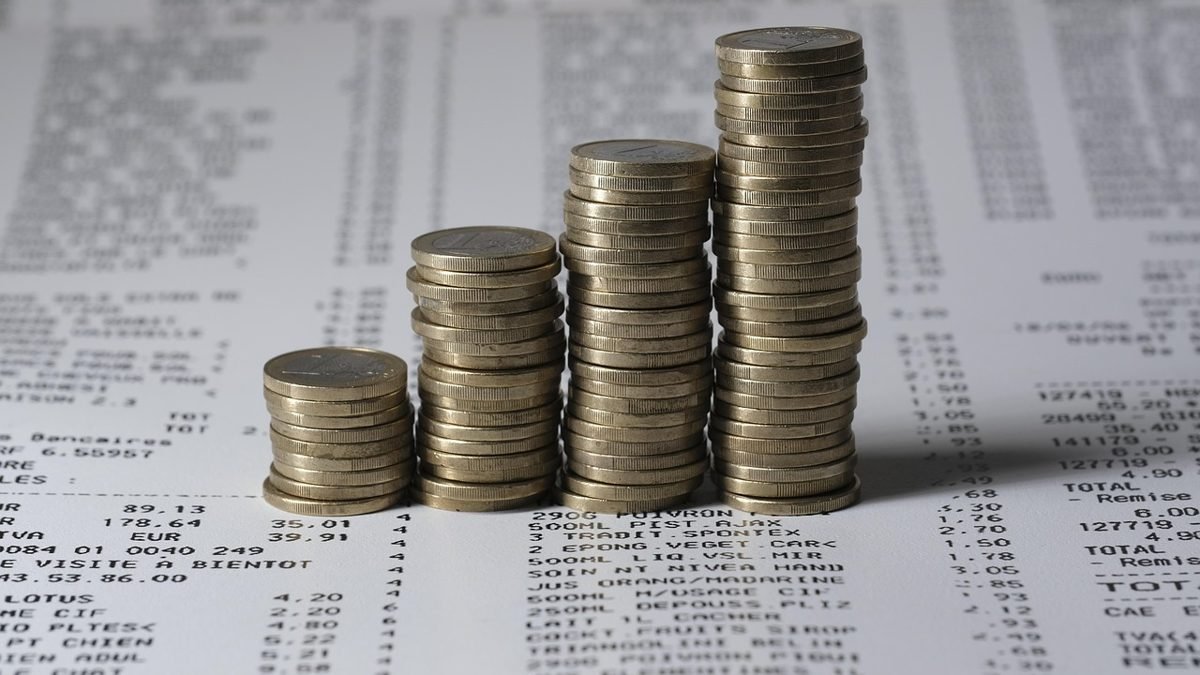
Take $10,000 at 7 percent for 30 years. With simple interest you earn $700 every year, for a total of $21,000 in interest and a final balance of $31,000. With compound interest, the same money grows to about $76,123. The difference, more than $45,000, comes entirely from interest earning interest.
| Years | Simple interest balance | Compound interest balance |
|---|---|---|
| 10 | $17,000 | $19,672 |
| 20 | $24,000 | $38,697 |
| 30 | $31,000 | $76,123 |
| 40 | $38,000 | $149,745 |
Where you meet each type
Simple interest shows up in some short-term loans, certain bonds and many auto loans. Compound interest shows up in savings accounts, certificates of deposit, retirement accounts, investment returns, credit cards and many other kinds of debt. Always check which kind you are dealing with before you sign.
The Compound Interest Formula, Explained Step by Step
The standard formula is A = P (1 + r/n)^(nt). It looks intimidating, but each symbol is simple.
What each letter means
A is the final amount. P is the principal, or starting amount. r is the annual interest rate written as a decimal, so 7 percent is 0.07. n is the number of times interest compounds per year. t is the number of years.
A worked example
Let P be $10,000, r be 0.07, n be 12 for monthly compounding and t be 10 years. Then A = 10,000 × (1 + 0.07/12)^(120), which equals about $20,097. That is the compound interest on a decade of monthly compounding, more than doubling the original deposit without adding another dollar.
The shortcut for annual compounding
If interest compounds once a year, the formula simplifies to A = P × (1 + r)^t. For $10,000 at 7 percent over 10 years, that is 10,000 × 1.967 = $19,672. You can enter this on any basic calculator using the power key.
Adding regular contributions
Most people do not invest once. They add money every month. For regular deposits, the future value formula adds a series of contributions, each compounding for a different length of time. Rather than doing this by hand, use a calculator. For example, $500 a month at 7 percent for 30 years grows to roughly $609,985, even though you only contributed $180,000 yourself.
How Compounding Frequency Changes Your Money
Interest can compound annually, quarterly, monthly, daily or even continuously. The more often it compounds, the more you earn, though the effect is smaller than most people expect.
Take $10,000 at 7 percent for 10 years. Compounded annually it reaches $19,672. Compounded quarterly it reaches $20,016. Monthly gives $20,097, and daily gives $20,136. Going from annual to daily adds about $464, which is nice but not life-changing. The rate and the time matter far more than the compounding schedule.
APR versus APY
The annual percentage rate, or APR, is the stated yearly rate without the effect of compounding. The annual percentage yield, or APY, includes compounding and shows what you actually earn or pay in a year. When comparing savings accounts, compare APY. When comparing loans, remember that the true cost can be higher than the quoted APR if interest compounds frequently. The Consumer Financial Protection Bureau explains how these terms work in its Ask CFPB library.
Where to earn real compound interest on cash
The best place for short-term savings is usually a high-yield savings account, where interest compounds daily or monthly. Rates change often and move with the Federal Reserve’s policy, so check current offers before opening one. Read our guide to high-yield savings accounts for what to look for.
Why fees can cancel compounding
A fund that charges a 1 percent annual fee takes a bite out of your return every year, and that bite also compounds. Over 30 years, a 1 percent difference in fees can reduce your final balance by a quarter or more. Choose low-cost funds when you can, as we explain in how to invest in index funds.
The Rule of 72: Doubling Your Money in Your Head
The Rule of 72 is a quick shortcut to estimate how long it takes for money to double. Divide 72 by your annual rate of return, and the answer is the approximate number of years.

Examples at different rates
At 3 percent, money doubles in about 24 years. At 6 percent, it takes about 12 years. At 7 percent, about 10.3 years. At 9 percent, about 8 years. That means a 25-year-old who invests at 9 percent could see money double about five times before retirement. The Rule of 72 is a fast way to feel how powerful compound interest is.
Use it in reverse
You can also find the rate you need. If you want to double your money in 6 years, divide 72 by 6 to get 12 percent. That tells you it is a stretch for a safe investment, which helps you set realistic goals.
It works for debt too
A credit card charging 24 percent doubles what you owe in about three years if you make no payments. That is compound interest at its cruelest. The Rule of 72 is a quick reminder to treat high-rate debt as an emergency.
Limits of the rule
The Rule of 72 is an approximation, most accurate for rates between about 6 and 10 percent. It ignores taxes, fees and inflation. Use it for quick thinking, then confirm the numbers with a calculator before you make a big decision.
Why Time Beats Amount: Starting Early
The most important lesson of compound interest is that time is the biggest lever you control. Compare two people who each invest $300 a month at a 7 percent average annual return until age 65.
Sam starts at 25 and invests for 40 years. He contributes $144,000 and ends with roughly $787,000. Taylor starts at 35 and invests for 30 years. She contributes $108,000 and ends with roughly $366,000. Sam put in only $36,000 more, but he finishes with more than $420,000 extra. Those ten early years did most of the work.
What this means if you are starting late
If you are 40 or 50, do not give up. Starting late is still far better than not starting, and a higher monthly contribution can make up much of the gap. The best day to start was years ago. The second best is today. For another angle on starting young, read our article on compound interest at 25.
The cost of waiting a year
Waiting one year costs you the final year of growth at the end of your investing life, which is the largest year. That is why delaying small amounts is more expensive than it looks. Automating contributions removes the temptation to wait.
Rates are not guaranteed
The numbers in these examples use a steady 7 percent for clarity. Real investment returns vary from year to year, and some years are negative. Long-term averages are not promises. Historical returns of broad stock markets have been higher than savings accounts over long periods, but they come with real risk. Diversify and invest for the long term.
When Compound Interest Works Against You
The same math that grows your savings also grows your debt. Credit cards, payday loans and some personal loans compound against you, and the effects can be brutal.
Credit card debt in numbers
Suppose you owe $5,000 at a 24 percent APR compounded daily and you make no payments for a year. Your balance grows to about $6,356, so you owe $1,356 in interest alone. If you make only minimum payments, it can take many years to pay off and cost thousands in interest. Our article on the real cost of credit card debt shows the fastest way out.
Student loans and capitalized interest
Unpaid interest on some student loans can be added to the principal, a process called capitalization. After that, you pay interest on a larger balance. Making interest payments while in school or during deferment can prevent this snowball.
Mortgages and amortization
On a mortgage, interest is calculated on the remaining balance each month. Early payments are mostly interest, which is why extra principal payments early in the loan save a lot. Try our mortgage payment calculator to see how extra payments shorten a loan.
Turn the tables
Paying off a debt that charges 24 percent is a guaranteed 24 percent return, which beats almost every investment. That is why the debt payoff methods in our guide on the debt snowball versus the debt avalanche should come before aggressive investing for most people.
How to Put Compound Interest to Work Right Now
Understanding compound interest is only useful if you act on it. These are the practical steps that turn the math into money.

1. Pay yourself first
Set up an automatic transfer on payday into a savings or investment account. Money that never reaches your checking account is money you do not miss. Even $50 a month matters when you give compound interest decades to work.
2. Capture the employer match
If your employer matches 401(k) contributions, that match is an instant return on your money before compounding even starts. Contribute at least enough to get the full match. Our guide on how a 401(k) works explains the basics.
3. Use tax-advantaged accounts
Retirement accounts let your growth compound without yearly tax drag. In a Roth IRA, qualified withdrawals are tax-free; in a traditional IRA or 401(k), you defer tax until you withdraw. For 2026, the IRA limit is $7,500, with a $1,100 catch-up for those 50 and older, and the 401(k) limit is $24,500. See our 2026 contribution limits guide and our walkthrough on how to open a Roth IRA.
4. Reinvest dividends and interest
Withdrawing growth stops compounding. Choose automatic reinvestment for dividends and leave interest in the account. That is how compound interest keeps building on itself.
5. Keep fees low
Look for funds with low expense ratios. Index funds and broad ETFs often cost far less than actively managed funds. Our guide on index funds versus ETFs compares them.
6. Increase contributions over time
Raise your contribution by 1 percent each year, or whenever you get a raise. This painless habit compounds along with your balance. If you are unsure how much to aim for, see our guide on how much to save for retirement.
7. Stay invested
Pulling money out during a downturn locks in losses and interrupts compounding. A long-term plan and a steady contribution schedule are the best protection. Our article on dollar-cost averaging versus lump sum investing explains how to invest through ups and downs.
8. Clear high-interest debt first
Because compound interest works against you on debt, paying off a 20 percent card is a bigger win than any investment. Do that, build a small emergency fund and then invest with confidence.
Common Myths About Compound Interest
A few misunderstandings keep people from using this tool properly. Here are the most common ones.
Myth: “I need a lot of money to benefit”
Compound interest rewards time and consistency, not big sums. A person who invests $100 a month for 40 years at 7 percent ends up with roughly $262,000. Starting small is far better than waiting to start big.
Myth: “A higher return is all that matters”
A higher rate helps, but chasing risky returns can wipe out gains. Steady contributions, low fees and time usually beat a lucky bet.
Myth: “Compounding is guaranteed”
Savings account interest is predictable, but investment returns are not. The formula shows what happens at a given rate, not what the market will deliver. Plan with conservative assumptions.
Myth: “Inflation does not matter”
Prices rise over time, so a dollar in 30 years buys less than a dollar today. Think in real, or inflation-adjusted, terms when you set long-term goals. A 7 percent nominal return with 3 percent inflation is roughly a 4 percent real return.
Myth: “Compound interest only applies to savings”
It applies to debts too. Understanding both sides makes you a better saver and a smarter borrower.
What Monthly Contributions Become: A Quick Reference
This table shows the future value of steady monthly deposits at a 7 percent average annual return, compounded monthly. It is a planning illustration, not a forecast, since real returns fluctuate. Use it to see how much compound interest adds on top of what you put in.
| Monthly deposit | After 10 years | After 20 years | After 30 years |
|---|---|---|---|
| $100 | $17,308 | $52,093 | $121,997 |
| $250 | $43,271 | $130,232 | $304,993 |
| $500 | $86,542 | $260,463 | $609,985 |
| $1000 | $173,085 | $520,927 | $1,219,971 |
How to read the table
Look at the $250 row. Over 30 years you deposit $90,000 in total, yet the account reaches about $304,993. More than half of that is growth you never had to earn through work. Compound interest does that quietly in the background, as long as you keep depositing and leave the money alone.
Choosing your own number
Start with an amount that does not strain your budget, even if it is small. Then raise it every few months. If you need help finding extra money to invest, our guide on how to create a budget shows where to look.
The power of an extra $50
Adding just $50 a month to a $250 plan lifts the 30-year total by roughly $60,999. That small step costs about $1.67 a day, and it is a reminder that every increase, however modest, pays off over time.
Mistakes That Slow Compound Interest Down
Most people do not fail because the math is hard. They fail because small habits quietly drain the growth. Watch for these common traps.
Cashing out at job changes
When you leave an employer, rolling your 401(k) into an IRA or your new plan keeps the money invested. Cashing out triggers taxes, possibly a 10 percent early withdrawal penalty and the loss of decades of growth. A $20,000 balance cashed out at 30 could have been worth over $200,000 by 65 at a 7 percent return.
Keeping too much in cash for too long
Cash is essential for emergencies, but long-term money left in a low-yield account falls behind inflation. Hold what you need for the next few years in safe accounts and invest the rest according to your timeline and comfort with risk.
Stopping contributions during a market drop
Falling prices let you buy more shares for the same dollars. People who keep contributing through downturns often benefit most when markets recover. Pausing contributions removes that advantage.
Ignoring high expense ratios
A seemingly small fee reduces every year of growth. Look at the expense ratio before you buy any fund, and compare it with a similar low-cost index fund.
Carrying a balance on a credit card while investing
Earning 7 percent while paying 24 percent is a losing trade. Pay off the card first, or at least capture an employer match while you tackle the debt.
Avoiding these mistakes keeps compound interest working at full speed. Each one is easy to fix, and each fix pays off for years.
Three Real-Life Compound Interest Scenarios
Seeing the math in different situations makes it easier to apply to your own life.
Scenario 1: A $2,000 emergency fund
If you keep $2,000 in a high-yield savings account at 4 percent, you earn about $80 in the first year. In 10 years, with no additions, the balance reaches roughly $2,960. Not exciting, but it is risk-free money that grows while you sleep, and it is what an emergency fund is for.
Scenario 2: A $5,000 Roth IRA contribution at 35
A 35-year-old who invests $5,000 once at 7 percent and never adds another dollar has about $38,000 at 65, more than seven times the original deposit. Add monthly contributions, and the result grows dramatically.
Scenario 3: $200 a month for a child’s future
Invest $200 a month from a child’s birth at a 7 percent return, and by age 18 the account is worth roughly $86,000, of which only $43,200 was contributed. This shows how compound interest rewards parents, grandparents and anyone who starts early, whether through a custodial account or a 529 plan. See our guide to 529 plans for college savings.
Where Compound Interest Grows: Accounts and Investments Compared
Not every account compounds the same way. Knowing what you own helps you decide where each dollar should go, depending on your goal and the time you have.
Savings accounts and money market accounts
These are the safest places to earn interest, usually insured up to $250,000 per depositor, per bank, per ownership category by the FDIC. Interest compounds daily or monthly, and rates move with the broader economy. They are best for emergency funds and goals within a few years. You can verify coverage on the FDIC deposit insurance page.
Certificates of deposit
A CD locks your money for a fixed term in exchange for a fixed rate. It is useful when you want a guaranteed return and will not need the cash early. Early withdrawal usually triggers a penalty, so match the term to your timeline.
Bonds and bond funds
Bonds pay interest, called a coupon, and reinvesting those payments produces a compounding effect. Prices move with interest rates, so bond funds can lose value in the short term even if they pay steady income.
Stocks and stock funds
Stocks do not pay a fixed rate. Their value grows through rising prices and, for many companies, dividends. When you reinvest those gains, the result looks like compound interest, but with ups and downs. Over long periods, broad stock funds have historically delivered higher returns than cash, with much more volatility. Our article on dividend stocks shows how reinvested dividends can compound.
Retirement accounts
A 401(k), IRA or Roth IRA is not an investment itself, but a wrapper that shields growth from yearly tax. Inside it you can hold funds that match your risk level. Because tax is delayed or removed, more of your money stays invested, and compound interest works on a bigger base.
Matching the account to the time horizon
Money you need in under three years belongs in cash or CDs. Money for goals five to ten years away can be a blend. Money for retirement decades away can lean heavily on stock funds. Rates and returns change, so what matters is that your choice fits the timeline.
How Taxes and Inflation Reduce Compound Interest
The headline rate is not what you keep. Two quiet forces shrink your real gains: taxes and inflation.
Taxes on interest and gains
Interest from a regular savings account is taxed as ordinary income each year, which reduces the amount left to compound. Investments in a taxable brokerage account may trigger capital gains tax when you sell. Tax-advantaged accounts avoid or postpone that drag. Read our guide to capital gains tax to see how it works.
The effect of inflation
If your savings earn 4 percent and prices rise 3 percent, your purchasing power grows by only about 1 percent. Savings that earn less than inflation lose real value, even though the balance looks bigger. For long-term goals, holding some growth assets protects against this.
A quick real-return check
Subtract the inflation rate from your return to see your real growth. A 7 percent return with 3 percent inflation is roughly 4 percent real, which is still enough to double your purchasing power in about 18 years using the Rule of 72. This is a better planning tool than ignoring prices.
Your Monthly Compound Interest Checklist
A short routine keeps the snowball rolling. Run through this list once a month.
Check that automatic transfers are working
Confirm your contributions went out on time. A missed month is a small loss, but a forgotten setting that lasts a year is a large one.
Review your rates
Compare your savings APY with current offers. If you could earn meaningfully more somewhere else with the same safety, moving the money costs you little and helps every month.
Look at your debts
List each debt’s rate and put extra money toward the highest rate first. Cutting a 22 percent balance does more for your net worth than most investment decisions.
Increase something by one notch
Raise a contribution by $10, $25 or 1 percent. Tiny steps feel painless, yet over decades they add up to a lot, thanks to compound interest.
Do not check your portfolio daily
Markets move up and down. Frequent checking tempts people to react emotionally. A monthly or quarterly review is plenty for a long-term plan.
Compound Interest Glossary
These terms come up whenever people discuss savings, loans and investments.
Principal
The original amount you save, invest or borrow, before any interest is added.
APR and APY
APR is the yearly rate without compounding. APY includes compounding, so it shows the true yearly growth or cost.
Capitalization
The process of adding unpaid interest to the principal so that future interest is calculated on a larger balance.
Amortization
The schedule by which a loan is paid off over time, with each payment covering interest first and then principal.
Expense ratio
The yearly fee a fund charges, shown as a percentage of the money you have invested.
Real return
Your investment return after subtracting inflation, which measures growth in purchasing power.
Questions to Ask Before You Open Any Account
Before you commit money, ask a few simple questions. They take five minutes and can save you years of lost growth.
What is the real yield after fees?
Ask for the APY on savings products and the expense ratio on funds. A small difference compounds into a big one over a long period, so always compare on equal terms.
Can I withdraw, and at what cost?
Some accounts charge penalties or limit withdrawals. Know the rules before you deposit, so you never have to break a good plan to cover a surprise bill.
Is my money protected?
Bank deposits are generally insured by the FDIC and credit union deposits by the NCUA, within limits. Investments are not insured against loss, so understand the risk you are taking.
Does this match my timeline?
A goal next year and a goal in 30 years need different tools. Matching the account to the date is the quiet step that keeps your plan on track.
What happens to the growth?
Check whether interest and dividends are paid out or reinvested automatically. For long-term goals, reinvesting keeps the engine running without any effort on your part.
Your First Three Steps This Week
Knowledge only pays when you use it. Pick these three actions and finish them in the next seven days.
Open or find the right account
If you have no emergency fund, open a high-yield savings account and set up an automatic transfer, even for $25. If you already have a cushion, check whether you are capturing your employer match and whether you could open an IRA.
Write down your numbers
Note your current balances, your monthly contribution and any debts with their rates. Seeing everything in one place makes the next decision easier and shows where compounding is helping or hurting you.
Run one projection
Enter your own figures in the calculator and look at the 20-year and 30-year results. Seeing a concrete target turns an abstract idea into a plan, and it makes the daily choice to save much easier to keep.
Repeat this routine every few months. Small, steady steps are exactly how compound interest turns ordinary income into lasting wealth.
Frequently Asked Questions About Compound Interest
What is compound interest in simple terms?
It is interest earned on both your original money and on previous interest. Each period your balance grows, so the next period’s interest is bigger.
What is the compound interest formula?
A = P(1 + r/n)^(nt), where A is the final amount, P is the principal, r is the annual rate as a decimal, n is how many times per year interest compounds and t is the number of years.
How often does interest compound?
It depends on the account. Savings accounts usually compound daily or monthly, certificates of deposit often monthly or quarterly, and bonds may pay semiannually. Credit cards generally compound daily.
Is compound interest better than simple interest?
For savers and investors, yes, because it grows faster. For borrowers, simple interest is cheaper. Check which type applies before you save or borrow.
How do I calculate compound interest?
Use the formula above, a spreadsheet or our compound interest calculator, which includes monthly contributions.
How long does it take to double my money?
Use the Rule of 72: divide 72 by the annual return. At 7 percent, it takes about 10 years.
Can compound interest make me rich?
It can build substantial wealth over decades if you contribute regularly, keep fees low and stay invested. It is not a get-rich-quick tool, but it is the most reliable way ordinary people build large balances.
The Bottom Line on Compound Interest
Compound interest rewards patience, consistency and low costs, and it punishes high-interest debt. The math is simple, the habit is the hard part. Start with whatever you can, automate it, raise it over time and let the years do the heavy lifting.
Ready to see your own numbers? Plug your balance, monthly contribution and expected return into our compound interest calculator, then explore our guide to investing in 2026 for next steps. This article is educational and not personalized financial advice.
Keep reading

How to Save for Retirement in Your 30s: 7 Easy, Smart Steps
How to save for retirement in your 30s: savings rate targets, employer match, 401(k), IRA and HSA order, 2026 limits, and worked examples.
Read the guide →
Traditional vs Roth 401(k): 7 Smart, Simple Facts for 2026
Traditional vs roth 401(k) explained: 2026 limits, tax math, employer match, RMDs and the Roth catch-up rule, with worked examples and a checklist.
Read the guide →
401(k) and IRA Contribution Limits 2026: Complete, Smart
The 401(k) and IRA contribution limits 2026 explained: $24,500 for 401(k)s, $7,500 for IRAs, catch-ups, Roth rules, phase-outs and deadlines.
Read the guide →Keep going: see the full Retirement Planning Guide: Accounts, Savings, Income for every guide on Retirement in a suggested order.